

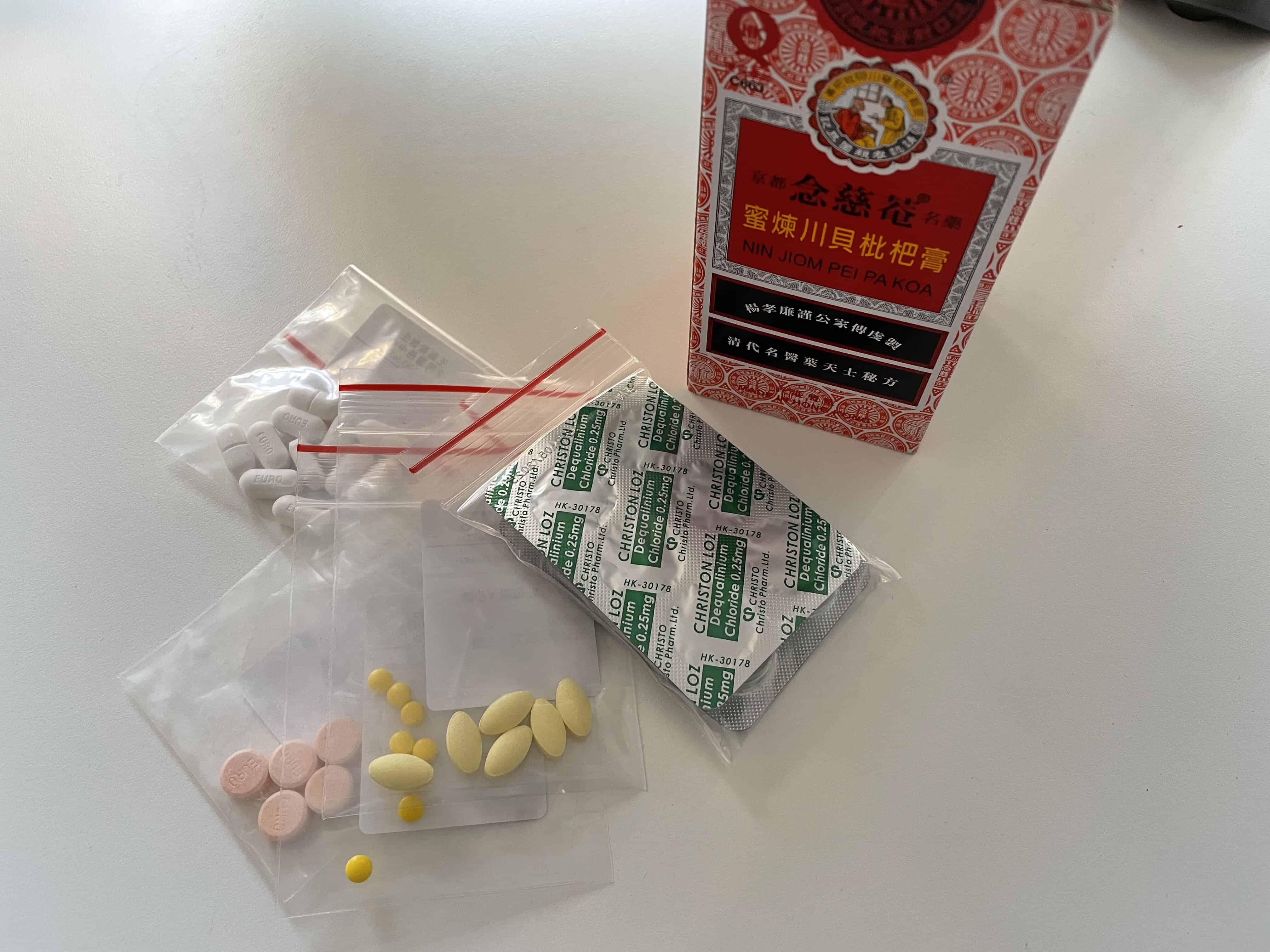
Welcome to my first weekly journal entry of the new year, published on the first day of the Lunar New Year. I started experiencing a sore throat on Wednesday, and I've been feeling constantly chilled and cold, with alternating periods of sweating and shivering at night. As I write this, I'm still not better. Although it's not COVID, I've seen a Western doctor and received some medication. While the medication is working, I feel better, but when it stops working, it's quite uncomfortable.
I don't know if it's because I stayed up too late working on this new repillow.co website last week and didn't get enough rest that I accidentally got sick. I thought it would be nothing serious and I could still work from home and get things done, but that's not the case. My throat hurts even when I swallow, and I feel completely drained and weak. I feel cold and sweaty at times, and it's even a bit difficult to sit in front of the computer and work.
Therefore, after taking my medication, I immediately work for two or three hours. When the effects of the medication start to wear off, I watch a movie. Today's journal entry is about the movies I watched while I was sick these past few days. I watched: White Hot : The Rise & Fall of Abercrombie & Fitch, Inside Bill's Brain : Decoding Bill Gates, Mars : Inside SpaceX, and today's topic: The Founder .
The Founder

This was my favorite movie while I was sick this week. The story is based on a true story, about how McDonald's grew from a small burger joint run by two brothers into a multinational corporation. The two brothers, Mac McDonald and Dick McDonald, were both employees, but feeling that "working for someone else won't get you anywhere," they started their own small burger joint. However, the high operating costs nearly forced them to close down. In this difficult situation, the younger brother, Dick McDonald, had a brilliant idea: to try a completely new, highly automated, assembly-line system for making burgers. Each employee would only be responsible for one part—frying fries or adding ketchup—to speed up the entire burger-making process and save costs. Initially, the Americans weren't very receptive to this kind of restaurant. Later, because it was indeed faster and cheaper, it attracted many people to eat there, and the restaurant often had long queues, which brought it back to life.
Around this time, they met a very unsuccessful salesman (in Hong Kong, he's called a "sales idiot") named Ray Kroc. His job was to go door-to-door selling automatic milkshake machines, but he never got many customers. Just when Ray was about to give up, the McDonald's brothers bought six milkshake machines from him. Ray was thrilled, but when he went to a McDonald's restaurant, he realized that McDonald's was no ordinary restaurant. A fully automated kitchen and assembly line operations—this was a huge business opportunity. His mind was no longer on selling those few milkshake machines; instead, he kept persuading the McDonald's brothers to expand and have McDonald's restaurants all over the United States. However, the McDonald brothers were somewhat resistant. They felt that as long as they could maintain quality in their small restaurant, they didn't need to expand nationwide. They believed that if they expanded nationwide, it would be difficult to maintain consistent quality. Neither of them were particularly ambitious; they just wanted a stable life with their small restaurant, enough to make a living.
Ray felt that they were being unfairly treated. He believed this was a huge opportunity and there was no reason for these two "unambitious" McDonald brothers to let it go so easily. So he spent every day at McDonald's, pestering the two brothers relentlessly. Finally, the two brothers couldn't stand him anymore and let him join McDonald's to work on franchising, which is essentially opening new stores.
After some time, McDonald's restaurants started to have branches in every state in the United States, but Ray faced a problem: although there were many McDonald's branches, neither he nor the branches in various places were very profitable. Selling those cheap hamburgers was not a very profitable business. In the worst case, Ray even mortgaged his house, and because of debts, the bank came to repossess his house. His life hit rock bottom.
At that time, he met a person in finance who taught him a trick: Every time McDonald's opened a new store, the Ray would first buy a piece of land and then rent it to the franchisee, so each Ray could collect rent. McDonald's was essentially in the real estate business; the hamburger business was just a way to pay for the land. Plus, the land would appreciate in value, and they could sell it later, still making a profit.
This move changed Ray's life and also brought McDonald's back to life.
Later on, Ray and the McDonald brothers bought the entire McDonald's company, giving them more autonomy. They eventually expanded the company further, opening more branches nationwide. The rest is history. Today, almost everyone knows McDonald's.
The story ends here.
Actually, this journal entry doesn't contain any particularly profound道理 (moral principles/philosophies). I just wanted to say that running a real estate business is like playing with fire; there will always be difficult times, especially when trying a new business. No one can guarantee success; on the contrary, many people fail. Like Ray in the McDonald's story, when the bank came to repossess his house, his wife was shocked. She asked, "Why are you taking out a mortgage on our own home to support your business?" This put Ray under immense pressure. At that moment, no one could have foreseen McDonald's success and could easily have felt despair. Of course, in retrospect, it's all just a process. So his perseverance was worthwhile; if he had given up then, there would be no McDonald's today.
Another benefit is that sometimes opportunities (1) require waiting and will appear when you least expect them (2) everyone has their own limitations in terms of knowledge and perspective, so there will be blind spots. Problems may not be seen, and even if they are seen, they may not be able to figure out how to solve them. At this time, you have to rely on outsiders. For example, when McDonald's was having financial difficulties, Ray did not think of it at all (and neither did I) that the problem was due to rent, and that they could use the sale of land to make hamburgers to earn income and support the business.


#033 The last weekly journal entry written on the old website (15/01/2023)
#035 Why hasn't a complete set of bed sheets, duvet covers, and pillowcases been sold yet? (29/01/2023)