

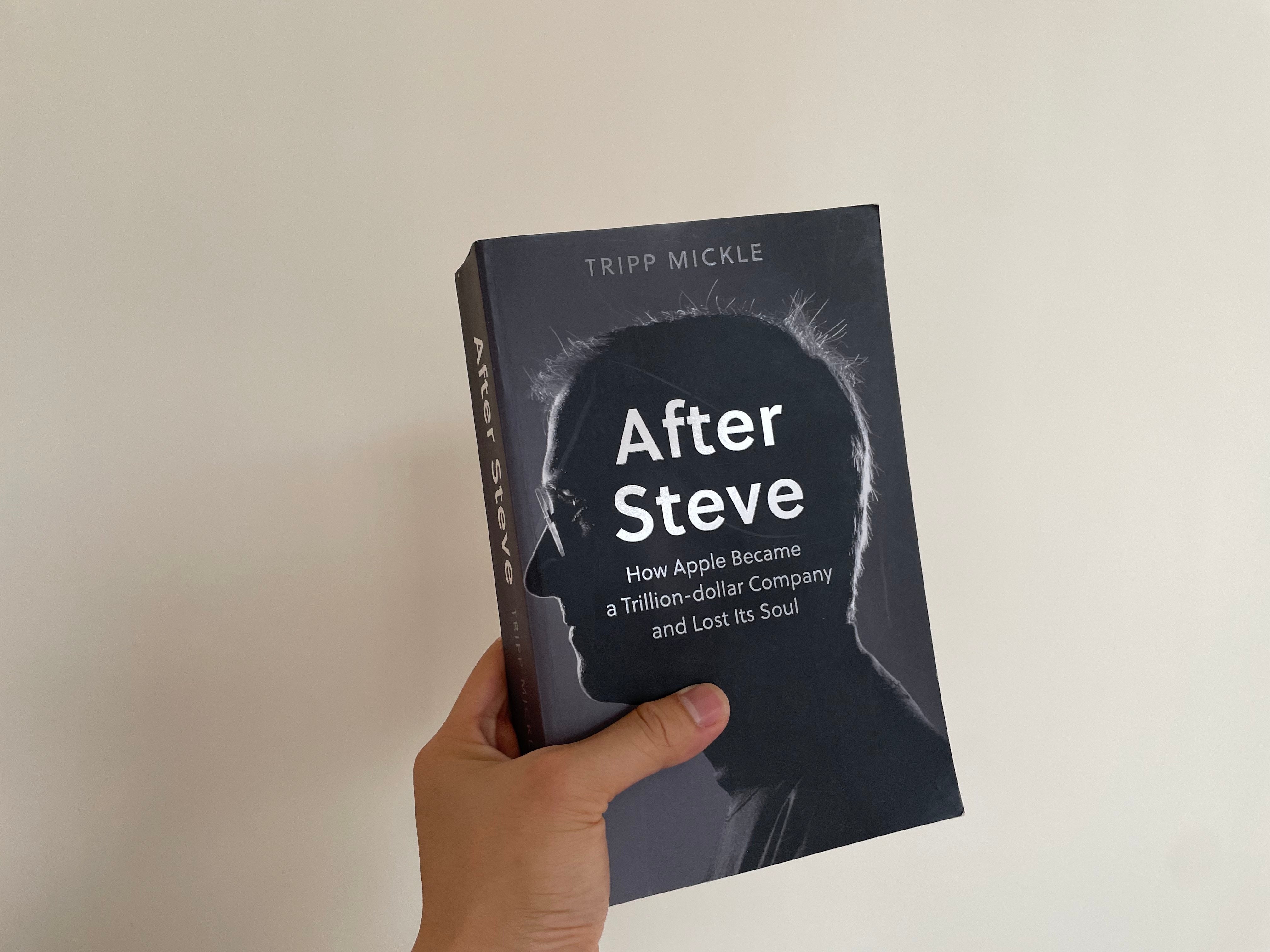
Welcome to this week's journal. This week, I finally finished reading *After Steve by Tripp Mickle*, a book of over 400 pages. I admit I used to be a huge Steve Jobs and Apple fan, so although this book is thick and contains a lot of Apple history and stories about the different people in management, some might find it boring. However, I thoroughly enjoyed reading it.
This book discusses the continued development of Apple after the passing of one of its founders, Steve Jobs, and explores what happened to different people within the company. How did they manage to forge their own path without this key figure, even achieving record-breaking revenue? What happened to the core team after Steve Jobs' departure, and did the company's direction change? So why read this book? What does it have to do with Re Pillow Co.? They're the prestigious Trillion Dollar Company, while we're just a tiny startup in Hong Kong. There is a connection: I think the principles are interconnected and applicable to us, although they're playing a much larger game. Actually, I've been interested in learning about other companies' business stories since high school. Others might find it boring, but I find it very interesting. You see, there are so many shops around the world, why do some street corner cart noodle shops become successful like Tam Jai? I don't think that having a big business means being good, not at all. I just think that what they did and what they didn't do, and the differences between them, will make a big difference later on. Understanding these differences and reflecting on them is interesting. Moreover, we should learn from the mistakes our predecessors made so that we don't waste time making the same mistakes again. Life is limited, and the reason why humanity as a whole can move forward is because we can learn from the experiences of our predecessors and continue on the foundation they built. When we have enough time, we pass it on to the next generation. So for me, reading books and learning from our predecessors is not only important, but essential. Perhaps it's easy for humans to feel that "things are different now" or "times have changed," which isn't wrong—every era has its own characteristics—but many principles and patterns have actually been repeatedly repeated throughout history. Humbly learn and maintain an open attitude towards everything. Although I am nothing, I hope to learn more and help Re Pillow Co. do better.
Designed by Apple in California
Since we're on the topic of Apple, let's talk about how Apple's design has influenced me. I admire Apple's (past) dedication to integrating design and technology. Tech companies have always focused more on functionality, perhaps due to their predominantly male-dominated nature. From IBM to Compaq, or the more widely recognized ThinkPad, they all exemplify "function over form"—the designs are often bulky but functional. Apple, however, takes design into account, and not just the appearance, but how the entire product works. Many of their designs are thoughtful and clever, achieving a "form follows function" approach. I think this is admirable, at least in the past. At Re Pillow Co., I'm also very committed to "purposeful design," meaning every design detail has a reason, because I believe these designs will stand the test of time.
How to make sales more stable
The book also mentions some noteworthy things Apple has done over the past decade. They changed their revenue structure, which previously relied almost entirely on products, to include other services such as iCloud, Apple Music, Apple Card, and Apple TV+. Because these are mostly recurring monthly fees, their revenue has increased significantly and become more stable. Previously, Apple relied on a single popular product for growth; if the product was unpopular, it could lead to significant budget shortfalls. For example, the iPhone 6s and Apple Watch were relatively unpopular, leading to the company feeling like "we are one bad product away from failing," creating immense pressure and financial instability. When I read this, I felt it resonated with my own situation. If a new product isn't popular, it's game over! Yeah! This is something I've been thinking about, and I have some initial ideas. I need to prepare further and launch it at the right time. Looking to the future, we must prioritize pragmatism, focus on making good products, understand our resource limitations, avoid being overly ambitious, and proceed gradually according to our capabilities in order to go far.

By the way, I got a T-shirt for the company this week. It has a bouncy Re logo, which looks a bit mischievous and stumbling. It actually symbolizes that life and work are not always smooth sailing. We grow through stumbles and falls. The most important thing is to have fun doing it and face the ups and downs of life with a relaxed attitude.


#059 Just be me(16/07/2023)
#061 Visiting Partners in Various Regions (30/07/2023)